17 June 2013

2012 'Essential Fire' Group Exhibition at Incinerator Gallery, Melbourne


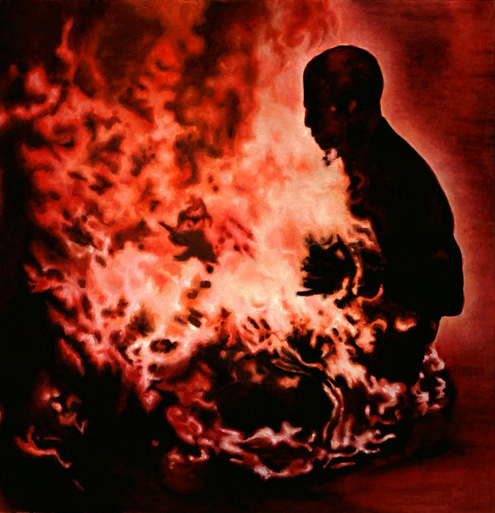
Essential Fire here represents the innate drive to create, to express self, and a reflection on what that means to us. For my contribution to the group show I have created an installation comprising of a home made telescope and an oil-on-canvas painting. 

The image of a burning monk is simultaneously awe inspiring and terrifying. I am at awe because to do such a thing as calmly and peacefully must require an incredible inner strength. I am at awe when I reflect on the human ability to sacrifice self for an ultimate higher cause. I am terrified of the human ability to sacrifice self for a higher cause, especially when one considers the events of the recent decades where we have seen this power be used to horrific ends. After all, what defines a higher cause is incredibly vulnerable to interpretation. 

The image of the burning monk represents a fascination with human mind and spirit to me, its complexities, its beauty and its pitfalls. It is my essential fire, what I burn for. Painting this image is an act of a desire to understand what it is we are made of, as is the act of constructing a scientific instrument which at once enables the viewer to observe the image and hinders it by not allowing a full scale view. And so it is,  that even as we seek to understand things we become increasingly aware of all that is yet obscured. 
(Artist Statement, Mariana Jandova, 2012)

15 June 2013

2011 'Final Frontier' exhibition at Trocadero gallery, Melbourne


The infinite blackness of space embodies a deeply ingrained fascination for us. For millennia we have gazed at the night sky and pondered the existence of things much larger than ourselves. So what is it about us that causes such malady? Why do we dream of space travel?

We pay witness to a time where the initial excitement about the future of space travel has turned into a more sobering reality of funding issues, extreme technical challenges and the promise of lives yet to be lost to accident or sacrificed to the sheer time requirements involved in traversing this void to even our nearest neighbouring planets let alone to a possible life sustaining 'other' Earth light years away. As we are steadily running out of resources we are starting to question the need to invest vast amounts of energy into these programs. Can we really afford to keep this pace? At what cost? Can we afford not to? If we take into account the recent announcements by the scientific community that if we continue growing at the rate we currently are, as soon as 2030 Humanity will require 2 planets to support itself.


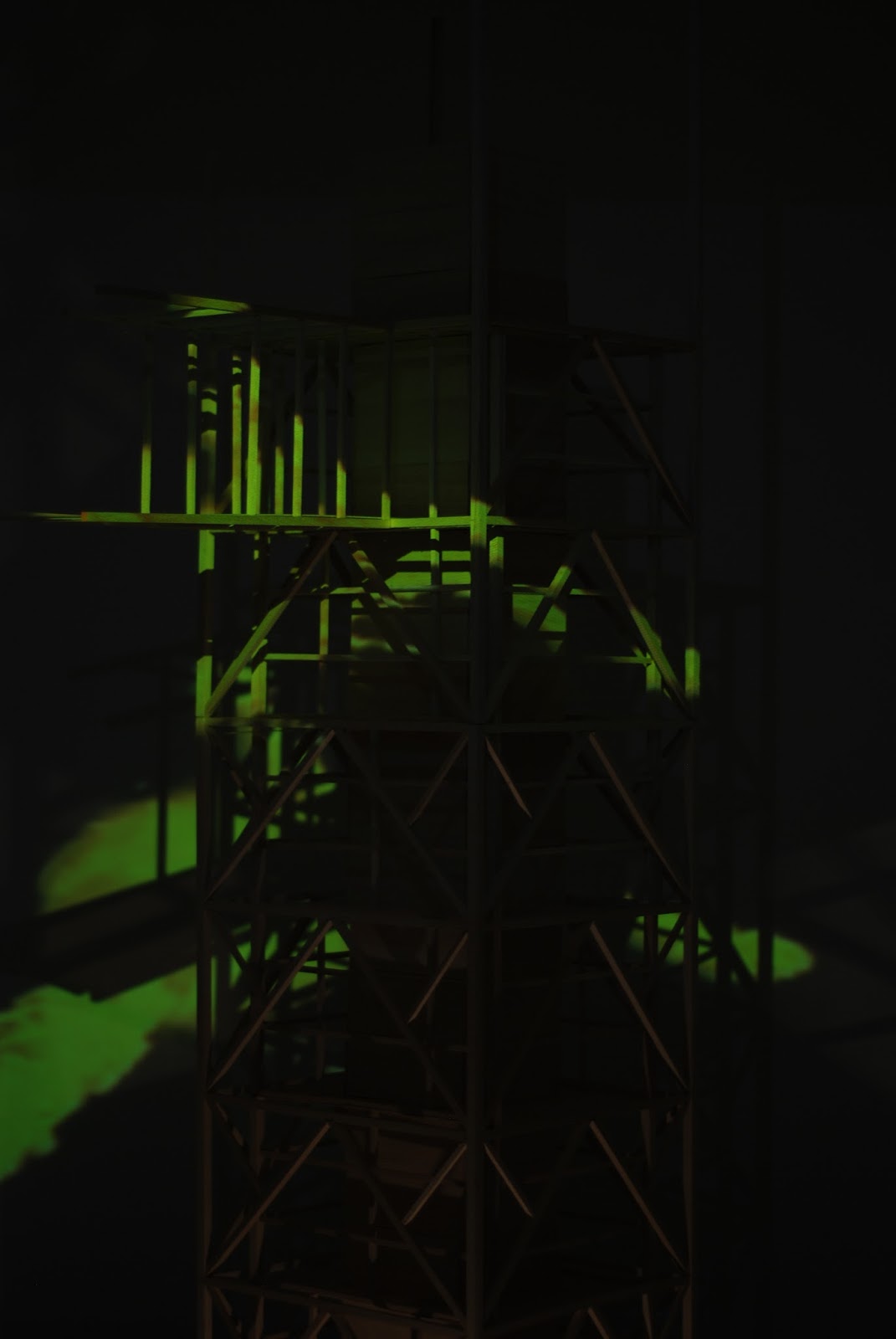
A tall unfinished copy of ARES 1 rocket launcher commissioned by NASA that would have seen the return of lunar exploration had it not been subsequently abandoned due to lack of funds stands alone in a darkened space. An abstracted play of light sourced from close-up shots of fireworks reminiscent of supernova cataclysms and birthing of stars creates the lighting for the launch tower in totality.
The fragile incomplete tower, placed on a black perspex reflecting its image like a dark mirror, is constructed out of thin sheets of soft balsa wood giving the appearance of balancing on the edge of collapse.
(excerpt from proposal, Mariana Jandova, 2011)

11 May 2013

2011 'Home Outside the Perimeter' Exhibition at Platform, Melbourne (collaboration with Tony Cran)


Tree houses are places of longing and escape. Memories of childhood, counterculture movements and humanity's roots are evoked in an instant at the sight of them. These miniature worlds offer a post-apocalyptic vision of the plants we call weeds – those hardy and resilient pests of the plant kingdom - as stand in and replacement for trees becoming neo trees, a new home for the human primate.

Utilising the Platform window boxes visually in a similar manner to their original purpose, hovering on the edge of being at once a museum exhibit (a relic of the past) and an architectural model (a plan for the future); we  placed within them weeds we made out of artificial flowers occupied by model tree houses. To further enhance the sensation of the work, a photographic diorama was installed on the walls and the floor of the boxes depicting vacant lots and disused spaces throughout the city. 


If we hope to live in harmony with the natural world and not dominate it, we need to understand the drives of the culture we live in. To transform ourselves we need to look at the unwanted parts of our nature and our culture. To build a tree house in a weed is to embrace the overlooked, to be at ‘home’ with the unpredictable changes occurring in our physical and social landscape.
(excerpt from proposal, Mariana Jandova & Tony Cran, 2011)


09 May 2013

2010 Projections Show at the Library Artspace, Melbourne


What is reality? Is it something that is set, continuous, regardless whether there is anyone to experience it, or does it only exist in our minds, is it something we create? Is our perception of the world correct to what is really happening? 

The touchstone of this body of work is the intertwining of personal memories with documented history.

The Projections consist of three wall projected images, old photographs from childhood over which I painted my own memory of the events, how I felt at that time.
The centrepiece image is created out of two merging landscapes, one Australian (country Victoria), the other European (Brno, Czech Republic, the town of my birth), both deeply familiar to me, loaded with significance.

I pose a question, is it the camera recording events faithfully as it happened or is the only true reality the one we experience though our eyes and in our hearts. 
(excerpt from proposal, Mariana Jandova, 2010)